
A Guide to Scope 3 Emissions
& Sustainable Action
START YOUR CIRCULAR IT JOURNEY – CALL US ON 0161 282 4530
Public Sector Carbon Footprint
Spanning local, regional, and national bodies, all education sectors,
emergency services and the NHS.
As the UK advances towards its target of Net Zero by 2050, public sector bodies are under increasing expectation to lead the way. However, “decarbonisation” means vastly different operational challenges depending on whether you are managing a primary school classroom, an acute hospital ward, or a regional police control room.
To create meaningful change, leaders must look beyond basic energy bills and understand what truly makes up their organisation’s total carbon footprint.
Change may yet be driven by future government policy on Net Zero expectations but the sensible future of managing carbon emissions will not be changed and the deployment of refurbished assets in the Circular IT economy will remain a strong and likely mandated policy across the public sector.

1. Demystifying the Scopes:
What Makes Up Your Carbon Footprint?
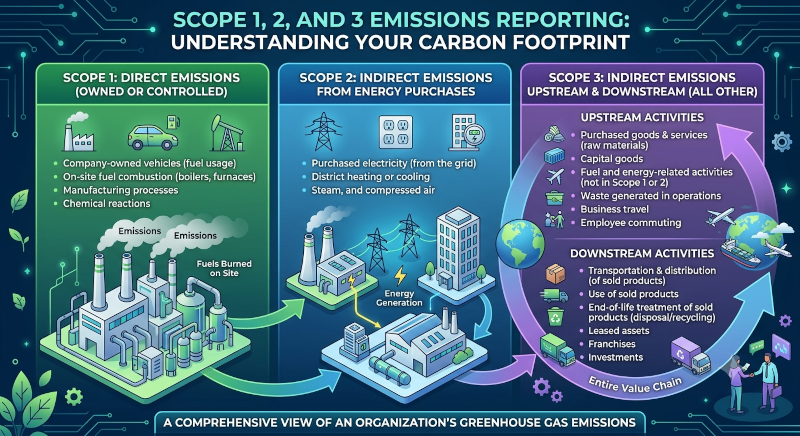
Under the global Greenhouse Gas (GHG) Protocol, an organisation’s
emissions are divided into three distinct categories:

Scope 1
(Direct Emissions):
Fuel burned on your sites (e.g., gas boilers heating classrooms or council offices) and direct tailpipe emissions from owned vehicles (such as ambulance fleets or fire engines).

Scope 2
(Indirect Energy Emissions):
Emissions generated off-site to produce the electricity, steam, or cooling that your facility buys and consumes.

Scope 3
(Supply Chain & Indirect Emissions):
The “hidden” operational emissions occurring upstream and downstream. This includes everything from staff commuting and operational waste to the embedded carbon of every physical asset purchased, manufactured, transported, and eventually disposed of.
2. Sector-by-Sector:
What Drives Your Footprint?
Every public sector organisation has a unique operational profile
that dictates where its carbon hotspots lie:

Public Sector Offices & Civil Infrastructure
- The Profile: High concentration of administrative desktop computers, multi-screen setups, remote-work hardware fleets, and centralized HVAC systems.
- The Carbon Hotspot: Scope 3 supply chain procurement—specifically high-volume IT refresh cycles—alongside daily commuting and leased estate energy.

LEA Primary, Secondary & Tertiary Education Sites
- The Profile: High student density, distributed IT suites, interactive classroom tech, and large catering infrastructure.
- The Carbon Hotspot: Thermal loss through older estate buildings (Scope 1) paired with recurring capital spend on high-volume user devices (tablets, Chromebooks, and desktop PCs).

NHS Trusts & Healthcare Sites
- The Profile: 24/7/365 critical operations, specialized medical diagnostic equipment, intensive sterilisation units, and large transport logistics.
- The Carbon Hotspot: Scope 3 dominates, representing roughly 75% of total NHS emissions. This includes medical devices, pharmaceuticals, and extensive digital IT infrastructure.

Emergency Services (Police, Fire, Ambulance & Coastguard)
- The Profile: Blue-light vehicle response fleets, mobilization control centres, and specialized field gear.
- The Carbon Hotspot: Heavy Scope 1 vehicle fuel usage combined with high-security, ultra-resilient IT hardware infrastructure that requires secure lifecycle management.
3. How Scope 3 Data Shapes
Central Government Policy
Under public sector frameworks like PPN 006 (formerly PPN 06/21) and the Greening Government Commitments, public bodies and their major suppliers must measure and report annually on Scope 1, Scope 2, and targeted Scope 3 metrics (such as waste, travel, and procurement activity).
How Government uses Public Sector Scope 3 Reporting to accurate shape policy:
- It creates standard benchmarks: Central government gains clear oversight of systemic supply chain vulnerabilities and high-carbon procurement patterns.
- It directs public funding: Aggregate data helps the Treasury target capital funds (e.g., the Public Sector Decarbonisation Scheme) toward interventions that offer the highest carbon reduction per pound spent.
- It drives supplier accountability: Public sector reporting prompts circular standards across commercial supply chains, rewarding vendors who offer low-carbon products.
- Circular IT will help and simplify your Scope 3 reporting tasks by providing Carbon Savings calculations and certificates for all refurbished or remanufactured products purchased from us.
4. Practical Energy Conservation Measures (ECMs)
Once an organisation maps its footprint, targeted Energy Conservation Measures (ECMs)
can yield immediate results and carbon reductions:
- Thermal Management: Retrofit smart thermostats and implement automated zone heating for ‘in use’ areas within 24 hour cycles.
- Building Automation: Retrofit older lighting arrays with LED replacements and movement sensors in communal areas to provide light only when needed. Heating and Lighting changes will help cut Scope 1 & Scope 2 baseline usage.
- Fleet Rationalisation & E-Mobility: Electrifying non-emergency transport fleets and optimising logistics routes.
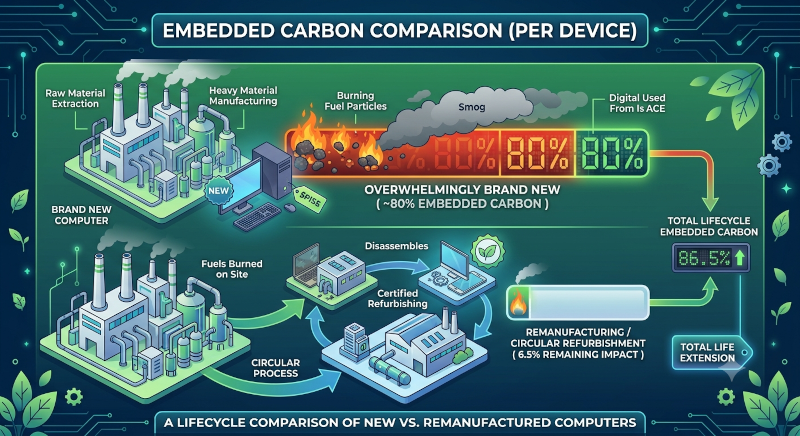
- Sustainable Digital Estate Management: Move to circular economy hardware choices when re-evaluating lifecycle choices. Refurbished IT will add around 6.75% carbon content against 80% new equipment purchases.
5. Spotlight on IT Procurement:
The Impact of Circular Hardware
When planning Scope 3 reduction measures, computer hardware represents one of the most accessible wins for public sector bodies. By adopting a Circular-First Procurement Policy, public sector bodies achieve substantial gains:
- Up to 80% of a standard computer’s lifetime carbon footprint is created before it is even plugged in—generated during raw material extraction, component refining, global transport, and factory manufacturing.
- Retaining Embedded Value:Retaining Embedded Value: Sourcing professionally remanufactured or refurbished assets avoids fresh manufacturing emissions, leaving only a residual ~6.5% embedded carbon footprint compared to newly built alternatives.
- Capital Protection: Refurbished, enterprise-grade devices typically deliver a 30% to 50% capital cost saving alongside equivalent warranties, preserving public funds.
- Closed-Loop Security: Pairing circular procurement with accredited Information Technology Asset Disposition (ITAD) protocols ensures old hardware is securely wiped (in alignment with UK GDPR or NCSC standards), refurbished, or recycled without entering landfill.

Conclusion: Taking the Next Step
Understanding your carbon footprint is not simply a compliance exercise—it is a tool to make public spending smarter, leaner, and more responsible. By looking closely at Scope 3 supply chain hotspots and choosing circular economy options for high-volume needs like ICT, every school, hospital trust, council office, and emergency authority can drive real progress toward Net Zero.
Key Takeaways for Public Sector Procurement
Scope 3 Matters: Upstream asset supply chains represent the largest portion of indirect public sector emissions.
Data Drives Decarbonisation: Regular annual footprint updates refine policy decisions locally and nationally.
Circular Sourcing Works: Reusing and remanufacturing IT hardware preserves up to 80% of embedded carbon while lowering capital expenditure.